Michelangelo API Framework
Michelangelo is an end-to-end ML platform that democratizes machine learning and makes scaling AI to meet the needs of the business as easy as requesting a ride. Michelangelo enables ML practitioners to seamlessly build, deploy, and operate machine learning solutions at Uber’s scale. It is designed to cover the end-to-end ML workflow: manage data, train, evaluate, and deploy models, make predictions, and monitor predictions. Michelangelo has been serving production use cases at Uber since 2016 and has become the de-facto system for machine learning for our engineers and data scientists.
Michelangelo consists of a mix of open-source systems and components built in-house. We generally prefer to use mature open-source options where possible and will fork, customize, and contribute back as needed, though we sometimes build systems ourselves when open-source solutions are not ideal for our use case.
Michelangelo is built on top of Uber’s data and compute infrastructure, providing a data lake that stores all of Uber’s transactional and logged data, Kafka brokers that aggregate logged messages from all Uber’s services, a Flink streaming compute engine, managed Cassandra/Redis clusters, and Uber’s in-house service provisioning and deployment tools.
An important piece of the system is Michelangelo API. This is the brain of the system. It consists of a management application that serves the web UI and network API and integrations with Uber’s system monitoring and alerting infrastructure. Currently, there is no industry-wide API standard for ML platforms and tooling, nor an end-to-end implementation reference available, and there’s no open-source initiative to tackle this problem. Teams and organizations tend to build their own APIs with no industry-wide agreed-upon standards, resulting in duplication of effort and incompatibility among ML products built by different teams.
Michleangelo has been field tested with highly complex real-world ML use cases at Uber’s scale, Michelangelo API Framework can help close this gap. We’d like to open-source the API framework which we’ve been building and improving in the past seven years, and to share our years of learning and experience building a highly scalable and reliable end-to-end ML platform with the ML community.
Architecture
Michelangelo defines the APIs using Protobuf as the IDL and the clients like UI, CLI and SDK can access the API via gRPC or HTTP/JSON. Michelangelo will support three SDK bindings by default including Python, Golang and Java. Any other language bindings supported by gRPC should work as well.
For detailed Michelangelo API definition, see the API Reference (coming soon).
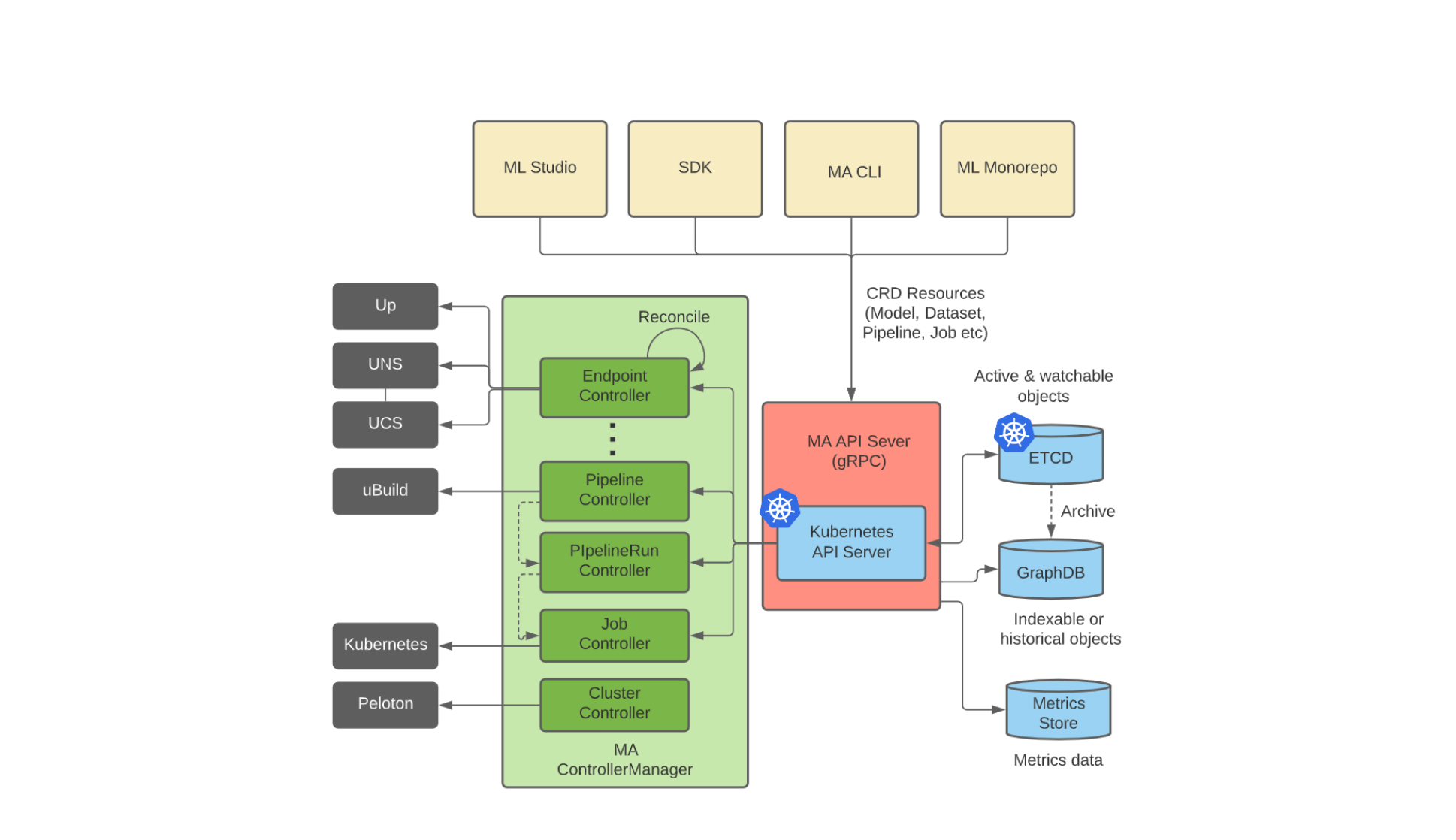
Figure below shows the high-level architecture of Michelangelo API framework that consists of the following components:
API Servers
Kubernetes API Server: A REST service that provides the standard methods for each CRD type (API resource type). Controllers monitor the creations / modifications of the CRD objects through the Kubernetes API server. Michelangelo users cannot directly call Kubernetes API server. Instead, they have to use Michelangelo API server (gRPC) or Michelangelo CLI(ma) to use Michelangelo APIs.
Michelangelo API Server: A gRPC server. For standard declarative API resources, Michelangelo API server is a gRPC to REST proxy. The APIs that do not fit into the declarative design are implemented in the Michelangelo API server such as Search APIs.
Kubernetes API server and MA API server will be packaged in the same docker container. Both k8s API server and MA API server are stateless. There can be multiple instances for high availability or scalability.
ETCD
ETCD is a strongly consistent key-value store that supports lock, leader election, and watching changes.
All the API resources (CRD objects) are stored in a global ETCD cluster. With API Hooks, API developers may store some of the API resource data into other storage systems (e.g. mysql, S3), while keeping the metadata in ETCD.
Controller Manager
Each controller monitors one API resource type. It’s a controller’s job to ensure that, for any given object, the actual state of the world matches the desired state (specification) in the object.
Currently, all the Michelangelo controllers are in a single process, i.e. Michelangelo Controller Manager. There will be multiple controller manager instances deployed into different availability zones for high availability. But at any time there is only one instance acting as the leader and others will be the followers.
Controller Manager uses ETCD to do the leader election (through
Kubernetes API server). Controller Manager is based on the Kubernetes open-source
framework, i.e. controller-runtime.
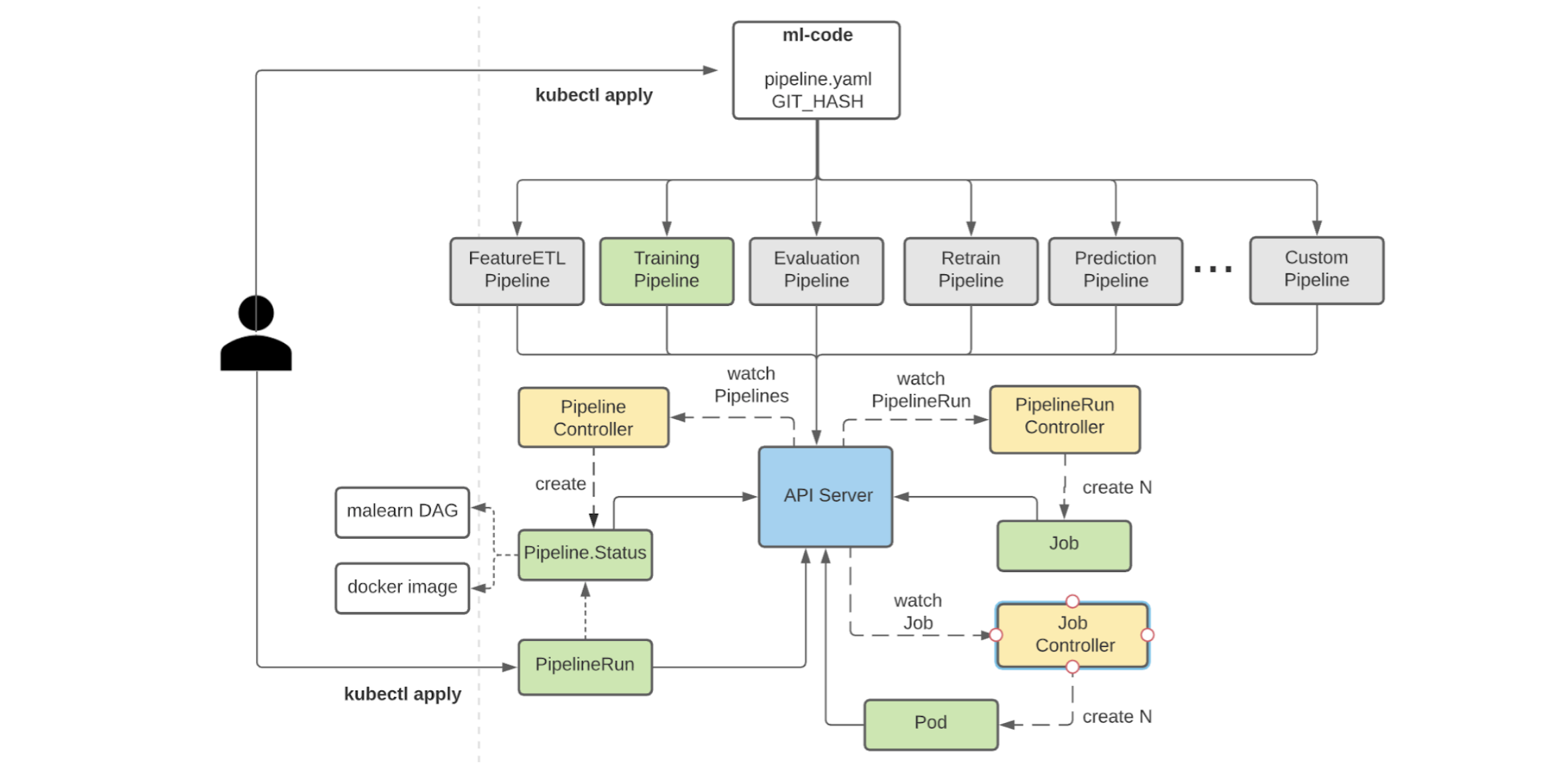
Figure below shows how different ML pipelines can be managed and executed using the Michelangelo API Framework.